
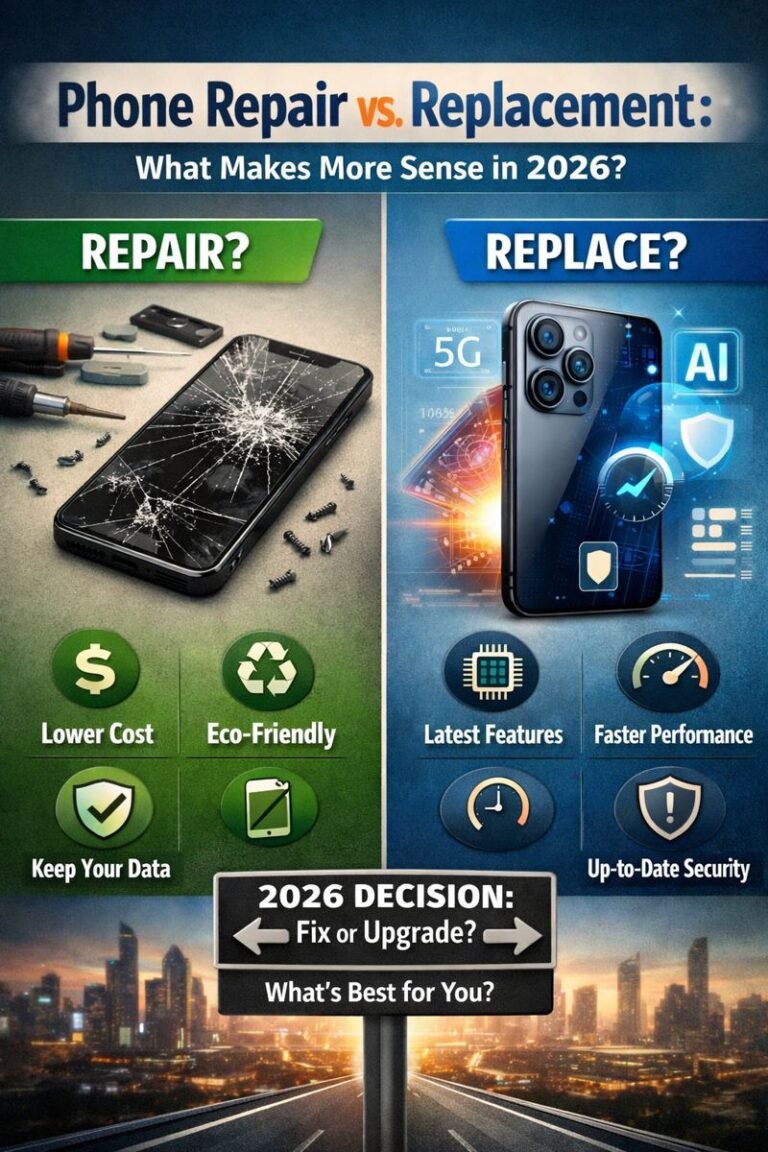
Smartphones have become essential tools for work, communication, entertainment, and daily life. As device prices continue to rise in 2026, consumers are increasingly faced with a common dilemma: should you repair your phone or replace it with a new one?
This decision is no longer just about cost. Factors like sustainability, software longevity, repairability, resale value, and performance upgrades now play a critical role. In this guide, we break down phone repair vs. replacement in detail to help you make the smartest decision in 2026.
Understanding the Smartphone Landscape in 2026
The smartphone industry in 2026 looks very different from just a few years ago:
- Flagship phones now cost significantly more than mid-range models
- Manufacturers are extending software support (5–7 years)
- Right-to-repair laws are expanding globally
- Consumers are more eco-conscious than ever
Because of these shifts, repairing a phone is often more viable in 2026 than it was before, especially for common issues like cracked screens, battery degradation, or charging port failures.
When Phone Repair Makes More Sense
1. Cost-Effectiveness of Repairs
In most cases, repairing a phone costs significantly less than replacing it. Common repairs include:
- Screen replacement
- Battery replacement
- Charging port repair
- Speaker or microphone repair
For example, replacing a worn-out battery can restore a phone’s performance for a fraction of the price of a new device. In 2026, improved aftermarket parts and repair tools have made repairs more reliable and affordable.
If the repair cost is under 40–50% of the phone’s current market value, repair is usually the smarter choice.
2. Extended Software Support
Major manufacturers now provide longer software and security updates. Many devices released in the last 3–4 years still receive:
- Operating system updates
- Security patches
- Performance optimizations
If your phone is still supported, repairing it can easily extend its usable life by another 1–2 years without sacrificing security or functionality.
3. Environmental Impact
Replacing a phone contributes to electronic waste, which remains a growing global issue. Manufacturing new smartphones consumes:
- Rare earth metals
- Significant energy and water resources
- High carbon emissions
Repairing your phone reduces environmental impact and aligns with sustainable technology practices. In 2026, many consumers actively choose repair as an eco-friendly alternative.
4. Data Convenience and Familiarity
Keeping your existing phone means:
- No data migration headaches
- No need to relearn a new interface
- No compatibility issues with accessories
For many users, the convenience of repair outweighs the appeal of upgrading.
When Phone Replacement Is the Better Option
1. Severe or Multiple Hardware Failures
If your phone has multiple major issues—such as motherboard failure combined with screen damage—the total repair cost can quickly approach or exceed the price of a replacement device.
In such cases, replacement often provides better long-term value.
2. Obsolete Performance and Hardware Limitations
Even with repairs, older phones may struggle to meet modern demands in 2026, including:
- Advanced AI-powered apps
- High-resolution gaming
- Enhanced camera processing
- Faster network standards
If your phone consistently lags, overheats, or fails to support newer apps, replacement may offer a noticeable quality-of-life improvement.
3. End of Software and Security Updates
Once a phone no longer receives security updates, it becomes vulnerable to:
- Malware and data breaches
- App incompatibility
- Performance instability
If your device is officially unsupported, replacement is often the safer and smarter decision—especially for business or financial use.
4. Major Technology Upgrades
Newer phones in 2026 often include:
- Improved battery efficiency
- Better cameras and AI photography
- Faster processors
- Advanced biometric security
- Improved durability
If these features significantly impact your daily use, replacement may justify the investment.
Repair vs. Replacement: Cost Comparison in 2026
| Factor | Repair | Replacement |
|---|---|---|
| Upfront cost | Low to moderate | High |
| Environmental impact | Minimal | Significant |
| Performance boost | Limited | High |
| Software lifespan | Depends on model | Full lifecycle |
| Convenience | High | Medium |
| Resale value | Moderate | Higher initially |
How Right-to-Repair Laws Are Changing the Game
In 2026, expanded right-to-repair regulations mean:
- Easier access to original or certified parts
- More independent repair shops
- Transparent repair pricing
- Longer device longevity
This has made phone repair safer, more reliable, and more mainstream than ever before.
Key Questions to Ask Before Deciding
Before choosing between phone repair and replacement, ask yourself:
- Is the phone still receiving security updates?
- Does it meet my daily performance needs?
- Is the repair cost less than half the value of the phone?
- Do I care about sustainability and reducing e-waste?
- Are new features truly necessary for my use?
Answering these questions will clarify the right path.
Expert Recommendation for 2026
Repair your phone if:
- The issue is limited (screen, battery, port)
- Software support is still active
- Repair costs are reasonable
- You want a sustainable option
Replace your phone if:
- Multiple major components are failing
- The device is obsolete or unsupported
- Performance limits affect productivity
- You need modern features for work or lifestyle
Final Verdict: What Makes More Sense in 2026?
In 2026, phone repair often makes more sense than replacement for most users. Rising device costs, improved repair options, longer software support, and environmental awareness have shifted the balance in favor of repair.
However, replacement remains the better option when performance, security, or hardware limitations outweigh repair benefits.
The smartest choice depends on cost, condition, usage needs, and long-term value—not just the age of the phone.
Ready to Decide?
If you’re unsure whether to repair or replace your phone, a professional diagnostic can provide clarity and help you choose the most cost-effective solution.